---
title: Why Most Consultancies Should Segment by Issue First and Industry Second
description: Most consultancies start with industries before diving into functions and capabilities. But once they do it, a quiet and destructive logic kicks in.
image: https://www.thevisibleauthority.com/hubfs/Blog/Why%20Most%20Consultancies%20Should%20Segment%20by%20Issue%20First%20and%20Industry%20Second.jpg
---
[](https://thevisibleauthority.com)
[](https://thevisibleauthority.com)
- [About us](https://www.thevisibleauthority.com/about)
- [Insights](https://www.thevisibleauthority.com/blog)
- [Contact](https://www.thevisibleauthority.com/support-request)
# Why Most Consultancies Should Segment by Issue First and Industry Second

[Florian Heinrichs](https://www.thevisibleauthority.com/blog/author/florian-heinrichs)
19 May 2026
Clients don't experience themselves as “in an industry.” They experience “having a problem.”
A CFO at a mid-size manufacturer doesn't wake up thinking "what would a typical industrial goods company do?" They think: "Our operational costs are up 15% year on year and I can't pinpoint where it's coming from. Who can help me fix that?"
That distinction sounds small. Commercially, it's enormous – and most consulting firms are organizing their go-to-market around the wrong one, leaving a lot of differentiation and streamlining potential untapped…
Let me explain:
## Industry-first segmentation: a proposition trap
Most consultancies start with industries before diving into functions and capabilities - and, I get it: The logic is seductively simple: Industries feel strategic. They mirror internal org charts. They make a firm sound like it has experience in (and relevance to) a defined space.
But once a consultancy defines itself by industry, a quiet and destructive logic kicks in: "We should cover as many needs in this industry as possible." Healthcare means strategy and digital, ops and change, and AI and cost optimization. Private Equity means value creation and portfolio ops, exit prep, and finance transformation. And so, the list grows. Each expansion seems justified. And each could be sustainable… if the firm had the means to support such a breadth. But in mid-sized consultancies, a collection of such decision sooner or later results in two very simple things: They overwhelm the group - and dilute the proposition.
Luk and I see this all the time: Specificity goes out the window. Focus gets lost. Senior leaders with different sector networks make different promises to different prospects. The portfolio expands. And the firm that once had a clear reason to be hired slides back into the hamster wheel of chasing clients – saying yes to everything, doing more to drive fewer results.
All in the name of being "relevant" in an industry.
But the simple truth is this: Industry plus capability tells a prospect what you've done and where. It doesn't tell them whether you understand their specific situation – and that gap is precisely where differentiation dies.
Specialization is not the same as (and, typically, less effective than) a proposition-led strategy!
## The pattern underneath industry segments
I know there is - and I suspect you might know already, too.
Because after sitting in a large number of industry-specific partner meetings across different consulting firms, a pattern becomes hard to ignore: in 80 to 90 percent of cases, the business problems being discussed and solved turn out to be (essentially) industry-agnostic.
Same pressures. Same buyer pain. Same dynamics playing out under the surface. Or, put slightly differently: Different industries, same problem.
The reason for this is straightforward: business issues travel across sectors far more readily than consulting firms tend to assume. Margin compression shows up everywhere, from healthcare and retail to industrial services. Failed transformations don't respect vertical boundaries. Integration problems follow acquisitions in whatever industry.
If the issue is real, it's almost certainly not unique to one sector.
Which means consultancies that lead with issues – rather than industries – can not only stay focused and specific… but have access to a far wider pool of genuinely fit prospects than their go-to-market suggests, too.
*Recommended reading: [How to Test a Consulting Value Proposition With Three Simple Questions](https://www.thevisibleauthority.com/blog/how-to-test-a-consulting-value-proposition-with-three-simple-questions)*
## What issue-first segmentation actually looks like
Shifting firms to issue-led segmentation isn't complicated. It has three steps:
Start with the core issue. What specific business problem does the firm actually specialize in resolving? Not capabilities, not service lines – the problem, in the client's language.
Add situational context. Where does that issue show up most acutely? What organizational conditions, trigger events, or structural pressures make it recognizable?
Use industry as proof, not positioning. Which sectors have you solved it in? That's where industry belongs – in the case studies, not in the headline.
The difference in practice is stark.
*Instead of:* "We serve Private Equity." *Try:* "We help PE-backed industrial firms fix value leakage in the first 180 days post-acquisition."
*Instead of*: "We focus on Healthcare." *Try*: "We help hospital groups redesign operating models when regulatory shifts compress margins."
The first kind of statement tells prospects where the firm has worked. The second tells them why to care.
And where “Capability + Industry” creates mere specialization (a helpful, but often no longer sufficient play… especially if a firm can’t prove truly deep industry expertise), “Issue-resolution + Industry” creates true relevance.
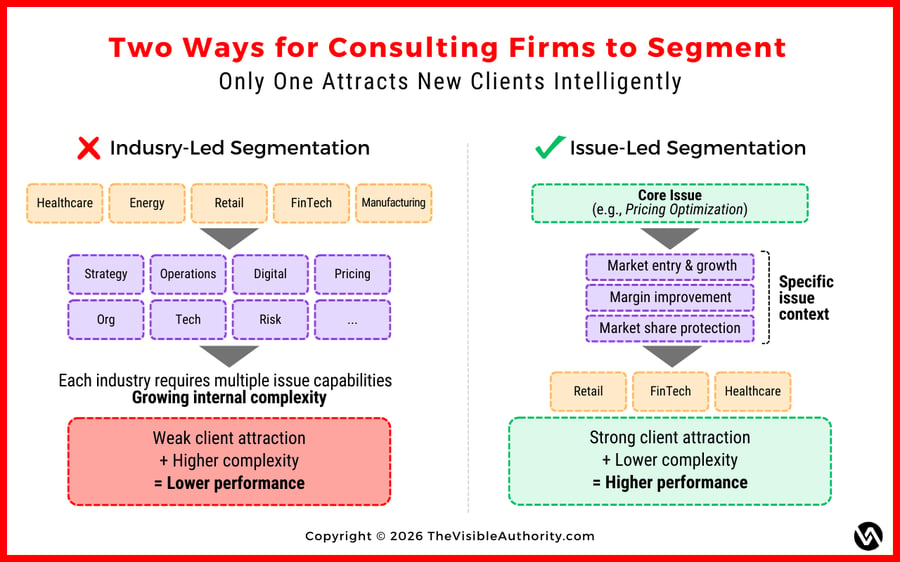*Two Ways for Consulting Firms to Segment*
## Industry still matters – just not where most firms put it
This isn't an argument for ignoring industry altogether. Context always matters. Regulatory constraints, technical complexity, buyer culture – these things shape how a problem shows up and how it gets solved. For a true single-industry specialist, leading with that sector is right.
But for most firms? Leading with a list of industries is leading with proof as if it were positioning. Every other consulting firm has the same slide. It creates sameness, not preference.
Industry belongs in the conversation – just later in it. It supports the issue-led story. It doesn't lead it.
## The organizing question
Firms that struggle to differentiate are worth asking one thing: are you organized around who the client is – or around what the client urgently needs to fix?
The first is industry-led. It feels comprehensive. It expands over time. It gradually becomes indistinguishable from the competition. The second is issue-led. It forces specificity. It improves over time. It creates the kind of pull that makes the right prospects recognize themselves in what the firm says – without the firm having to explain why it's different.
Issue first. Industry second – as proof.
********Interested in receiving all our learnings to build a better consulting firm?************[Subscribe to our newsletter.](https://share.hsforms.com/1T-1RM40GQySH0wJZP4M2aQ3gng9?__hstc=212170763.895d2a530d7462f57984a1f503d289b5.1658208848729.1658493022934.1658498148560.9&__hssc=212170763.17.1658498148560&__hsfp=398685282&hsCtaTracking=0c1c0b6a-8224-4adb-83e6-87af233f9a09%7C823b09a2-cd5b-49c7-aebb-90c179e62d05)********

[Florian Heinrichs](https://www.thevisibleauthority.com/blog/author/florian-heinrichs)
Florian brings over ten years of experience in consultancy business development and marketing across international agencies and in-house roles at Deloitte and Accenture. There, he helped form and grow an entirely new business unit within the firm, ensuring the organic growth required to hit the multi-billion-dollar unit’s high-reaching 25 % p.a. growth targets. His expertise spans marketing strategy, management, and sales enablement, complemented by robust skills in business development, service sales, and account management (he owned the office P&L in the last agency he worked for). As a partner and senior consultant at TVA since 2022, Florian focuses on refining business development strategies, enhancing value propositions, and optimising client journeys to drive business development ROI. His pragmatic approach ensures that essential elements are in place for firm growth and performance improvement.
Share this article on
[mailto:?subject=Check%20out%20Why%20Most%20Consultancies%20Should%20Segment%20by%20Issue%20First%20and%20Industry%20Second%20&body=Check%20out%20https://www.thevisibleauthority.com/blog/why-most-consultancies-should-segment-by-issue-first-and-industry-second](mailto:?subject=Check%20out%20Why%20Most%20Consultancies%20Should%20Segment%20by%20Issue%20First%20and%20Industry%20Second%20&body=Check%20out%20https://www.thevisibleauthority.com/blog/why-most-consultancies-should-segment-by-issue-first-and-industry-second)
## Further Reading
[](https://www.thevisibleauthority.com/blog/the-impact-of-a-clear-consulting-proposition-on-service-design)
##### [The Impact of a Clear Consulting Proposition on Service Design](https://www.thevisibleauthority.com/blog/the-impact-of-a-clear-consulting-proposition-on-service-design)
Refining a consultancy's proposition doesn't just clarify its promise. This foundational change...
[Read more](https://www.thevisibleauthority.com/blog/the-impact-of-a-clear-consulting-proposition-on-service-design)
[](https://www.thevisibleauthority.com/blog/how-to-structure-multiple-value-propositions-without-losing-your-firms-identity)
##### [How to Structure Multiple Value Propositions Without Losing Your Firm’s Identity](https://www.thevisibleauthority.com/blog/how-to-structure-multiple-value-propositions-without-losing-your-firms-identity)
For leaders of multi-service consultancies, one challenge crops up time and again: how do you...
[Read more](https://www.thevisibleauthority.com/blog/how-to-structure-multiple-value-propositions-without-losing-your-firms-identity)
[](https://www.thevisibleauthority.com/blog/most-consultancies-design-their-own-scope-creep)
##### [Most Consultancies Design Their Own Scope Creep](https://www.thevisibleauthority.com/blog/most-consultancies-design-their-own-scope-creep)
The complaint appears almost word-for-word across consulting firms of very different sizes and...
[Read more](https://www.thevisibleauthority.com/blog/most-consultancies-design-their-own-scope-creep)
### Info
**The Visible Authority is a brand of:**
TVA & Partners BV (legal entity)
Jan Verbertlei 37
2650 Edegem
Belgium
[contact@thevisibleauthority.com](mailto:contact@thevisibleauthority.com)
### Menu
- [About Us](https://www.thevisibleauthority.com/about)
- [Insights](https://www.thevisibleauthority.com/blog)
- [Contact](https://www.thevisibleauthority.com/support-request)
### Connect with us on LinkedIn:
[Luk Smeyers](https://www.linkedin.com/in/luksmeyers/)
[Florian Heinrichs](https://www.linkedin.com/in/fmheinrichs/)
Copyright © 2025 The Visible Authority - All Rights Reserved. - [Privacy Policy](https://www.thevisibleauthority.com/privacy-policy)