10 Lessons Boutique Consultancy Owners Can Take Away from My Newsletter Strategy
Email is the third-highest owned media platform B2B marketers use to distribute content, reports...
Read more


Many consulting firms pride themselves on being open to everything. They want to keep as many doors open as possible, stay broad in their positioning, and remain ready to respond to whatever the market brings. On paper, this looks like a sensible strategy: more options, more potential revenue streams, more chances to say yes to attractive clients.
In practice, this posture slowly reshapes how the firm makes decisions. Projects that sit slightly outside the core expertise become acceptable. Scopes are adjusted to fit whatever the client requests. Proposals are written from scratch because every opportunity feels unique. Delivery approaches evolve around individual preferences rather than a shared model.
Over time, this way of operating stops being the exception and becomes the norm. The firm is no longer guided by a clear set of choices about who it serves, what problems it solves, and how it creates value. Work is won and delivered through a series of one‑off responses to immediate demand.
What feels like healthy flexibility at the beginning gradually turns into something else: a consulting business that runs on improvised decisions, improvised projects, and improvised ways of working. Growth becomes harder to predict, teams feel stretched in too many directions, and profitability comes under pressure even when the firm appears busy.
In our work with consulting firms, this is one of the most common patterns we see across boutiques and practices/verticals within large firms. No consulting firm, regardless of size, is automatically protected from it.
Typically, requests are phrased along the lines of “We are doing everything we can think of but our growth feels unpredictable, the business development and marketing strategies we’ve tried are not delivering the desired results, and the entire team is running on fumes.”
Once we look under the surface, we find that improvisation has quietly become the default mode of operation and the underlying cause driving this reality.
Improvisation is one of the primary root causes of a consulting firm’s profit erosion. That is why, in this article, I will walk through the causes and negative impacts of improvisation, explain the forces that drive it, and outline an alternative operating model.
Improvisation, as a profit-eroding mode of operations, is not something that happens overnight. It’s a pit that consulting firms slip into, one decision and one compromise at a time.
It typically starts with a deliberate decision to stay broad. “We want to keep our options open and maintain as many revenue avenues as we can,” is what consulting leaders and owners often say.
Big mistake. This mindset impacts every aspect of the consulting firm’s operations:
It takes on projects outside of the core expertise;
Its marketing and business development strategies lack the focus, targeting, and messaging that would make them effective;
Resources are allocated on an ad-hoc basis. No planning or foresight;
Projects are endlessly customised, and most requests for additional work or expanded scope from clients are met with a yes;
Talent is hired not based on projected growth but in response to the immediate pressure of ongoing projects;
Pricing is constantly adjusted and negotiated;
Individual consultants and their approach to clients are what usually determine the success of projects and clients’ satisfaction with outcomes.
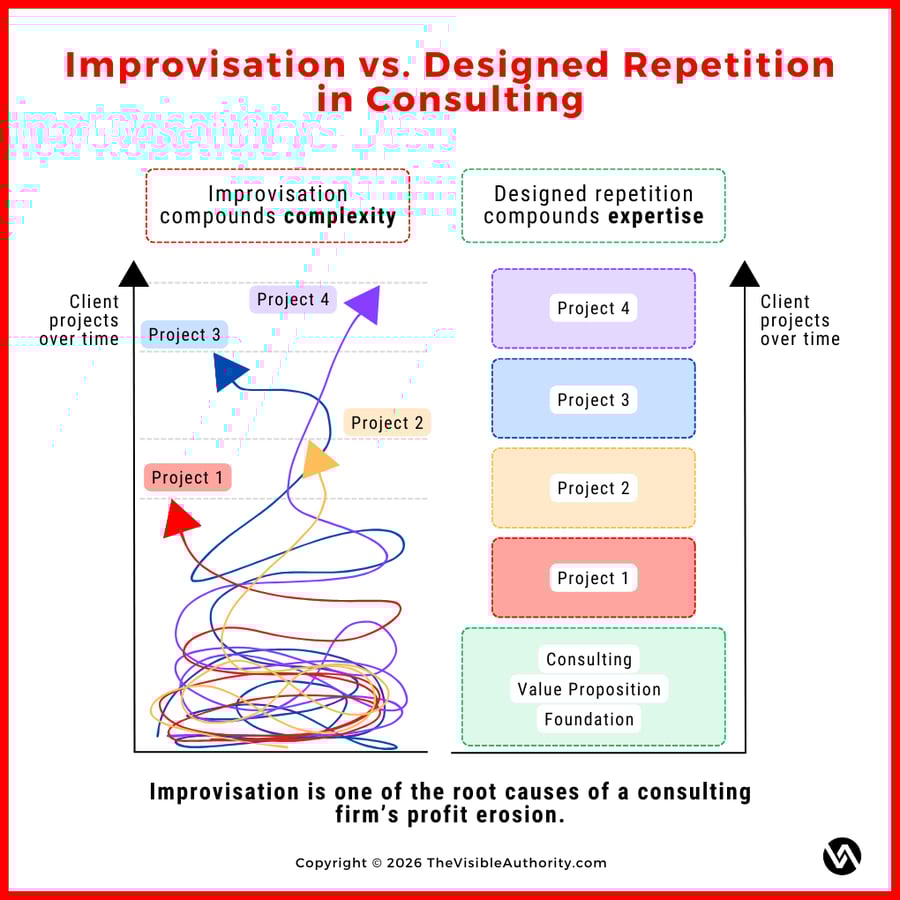
When a consulting firm improvises, every client project becomes a new invention. The work starts from scratch again and again. That constant reinvention adds variation, and variation quickly turns into complexity.
The impact of that improvisation on the bottom line shows up fast and in predictable ways:
Operational strain: Operations become harder to manage when every project follows its own logic. Consulting firms often swing between periods of work overload and periods of slow work. Resources are either under- or overutilised. There is no predictability in how to allocate the time of consulting teams and tech resources.
Diluted expertise: Knowledge spreads thin because patterns never get reinforced. Every project is a learning curve. Knowledge gained in one project does not necessarily translate into an asset for another project. Expertise doesn’t compound. It just gets broadened.
Profit pressure: Margins shrink quietly as effort increases without leverage. The inability to optimise resources and the lack of predictability in how staff’s time is allocated in the most efficient, value-driven way increase the costs of completing each project. Pricing, on the other hand, constantly fluctuates. Revenue is unpredictable.
Power to the client: The client defines the scope, the approach, and often the price. There are no methodologies, clear onboarding processes, client success journeys, or other strict parameters. The relationship dynamic with clients changes from strategic advisors and experts to order-takers.
Improvisation is not inherently bad. Every consulting project involves a certain degree of improvisation. Built-in flexibility allows consulting firms to continuously deepen and sharpen their expertise.
The problem is when improvisation takes over. When a prospect asks for yet another “something”, the consultancy says yes, even when there is a well-defined process behind it.
And the root cause of it? The lack of a strong consulting value proposition: issue-led, outcome-driven, and client-specific.
The modern buyer can smell when a consultancy is pitching work that sits outside its comfort zone. The signal is simple: there is insufficient evidence that this work has been delivered repeatedly with predictable value. When that proof is missing, the buyer starts negotiating from a very different place.
The core issue is rarely the client, but the consultancy proposing something that hasn't yet been turned into a repeatable proposition. Without clear proof, strong client successes, and a confident approach to pricing the work, the consultancy weakens its position before the project even starts.
There is no laser-sharp value proposition to define the parameters of work, pre-qualify prospects, establish repeatable processes and methodologies, guide marketing and business development strategies, or frame thought leadership at the foundation of trust-building.
The real danger of improvisation is its compounding effect.
Each improvised project adds another layer of complexity to what already exists. What feels flexible and responsive in the early days slowly snowballs into a consultancy that is busy, chaotic, and stuck managing its own variability.
 Improvisation vs. Designed Repetition in Consulting
Proposition design is how consulting firms can claim back control over their consulting operations, performance, and growth.
A well-defined consulting proposition gives the consulting firm a solid foundation, eliminating the need to improvise every time. It creates a deliberate frame for making decisions on such crucial business issues as:
To whom the consulting firm delivers its services;
What problems it solves for this audience;
How it solves the problems – from expertise needs to resources to processes and methodologies;
When the consulting services are relevant and can provide exponential value, and when it is best to decline a new project;
How to price the services based on the value they provide as opposed to the man-hours poured into the delivery;
What minor adjustments are needed for proposals, which are now, for the most part, standardised due to the repetition in the kind of work is performed for the same type of clients;
What subjects to write about to address critical issues for the target audience and, through that, build trust with it;
How to onboard new hires;
How to onboard new clients;
What chain of services would maximise the value for the client and facilitate a long-term relationship.
Furthermore, when consulting firms repeat work by design, expertise compounds. That shows up as:
Pattern recognition: Similar problems make similarities visible. By spotting early signals, common failure points, and the most effective interventions, the consultancy can do so faster and with greater precision than competitors.
Reduced outcome variance: Delivery becomes more predictable over time. Repeatable work enables consulting firms to continuously optimise their approach, whether through the tools used, methodologies, or processes. This, in turn, means that timelines become predictable, the effort required for each project is calculable, and the outcomes are predictable.
Stronger confidence: Teams know what works and why. Their confidence grows from evidence: clear delivery approaches, predictable outcomes, and happy clients. Decision-making within teams becomes faster. Internal alignment shows up in every aspect of business – from project delivery to marketing and sales.
Pricing resilience: Confidence in delivery supports firmer pricing. It no longer needs to price services by the hour but rather by the value they deliver. Clients are more willing to pay premium fees because the consulting firm reduces complexity and provides evidence of its ability to deliver outcomes.
In our experience, consulting firms that make this shift stop compounding complexity and start compounding expertise.
Recommended reading: The Ultimate Guide to Consulting Value Proposition Design
I often get the question: can a consulting firm never leave its zone of expertise anymore (once defined)?
Of course, it can! The goal of a value proposition-driven operations strategy is to turn flexibility into a tool in a big toolbox rather than letting it take over.
This means that when a consulting firm is driven by its strong value proposition, it deliberately leaves its comfort zone. For example, it may want to test a new proposition – aka innovation. And it does so with clear boundaries, a learning goal, and an explicit plan to scale it.
Exploration, in these instances, is a strategic choice. It is not driven by short-term revenue pressure. It is not forced upon the consultancy, nor does it affect its performance. Improvisation happens inside a structure. A sandbox environment, if you will.
Without that discipline, exploration turns into accidental portfolio sprawl, and improvisation quietly hardens into complexity (and an impact on profitability).
Improvisation is not inherently bad. It becomes dangerous when it starts running the show. When it turns consulting leaders and owners into reactive decision-makers instead of strategy-setters. It becomes a problem when clients are forced to get in the driver’s seat and dictate the scope and delivery.
Left unchecked, the negative impacts of improvisation compound. Every new project adds complexity. Complexity corrodes efficiency, erodes profitability, and stalls growth.
A strong, outcome-driven, issue-led, and client-specific consulting value proposition is a way to put a consulting firm back on track. To grow by design. Proposition-driven strategies contain improvisation. They use flexibility to power predictable growth through continuous optimisation of resources and processes.
Improvisation should not run the show. Consulting growth can not be at the mercy of a couple of big projects or tied to a handful of clients. Consulting firms that find themselves in this position need to press the brakes and go back to the value proposition drawing board.
Interested in receiving all our learnings to build a better consulting firm?
Subscribe to our newsletter.