Consulting Clients Don’t Have a Tool Problem
In the last couple of years, we have worked with a wide range of IT and software consulting firms...
Read more


This article was last updated on 24 March 2026.
A consulting firm walked into a boardroom at a global pharmaceutical organisation that was undergoing a complex merger.
Two legacy organisations, two distinct systems, overlapping CRM and ERP environments, regulatory constraints, multiple countries, and dozens of teams had to be brought together into a single operational reality.
This post-merger ERP integration had to be executed without disrupting ongoing operations, while ensuring stakeholder alignment across regions and functions. The stakes were incredibly high because any mistake had the potential to cost a lot of money, time to success, revenue leakage, and market credibility in an already tense situation.
What made this pitch remarkable became clear very quickly. The client ultimately selected this consulting firm over much larger, global consulting firms, including a Big Four competitor with an established presence in the organisation.
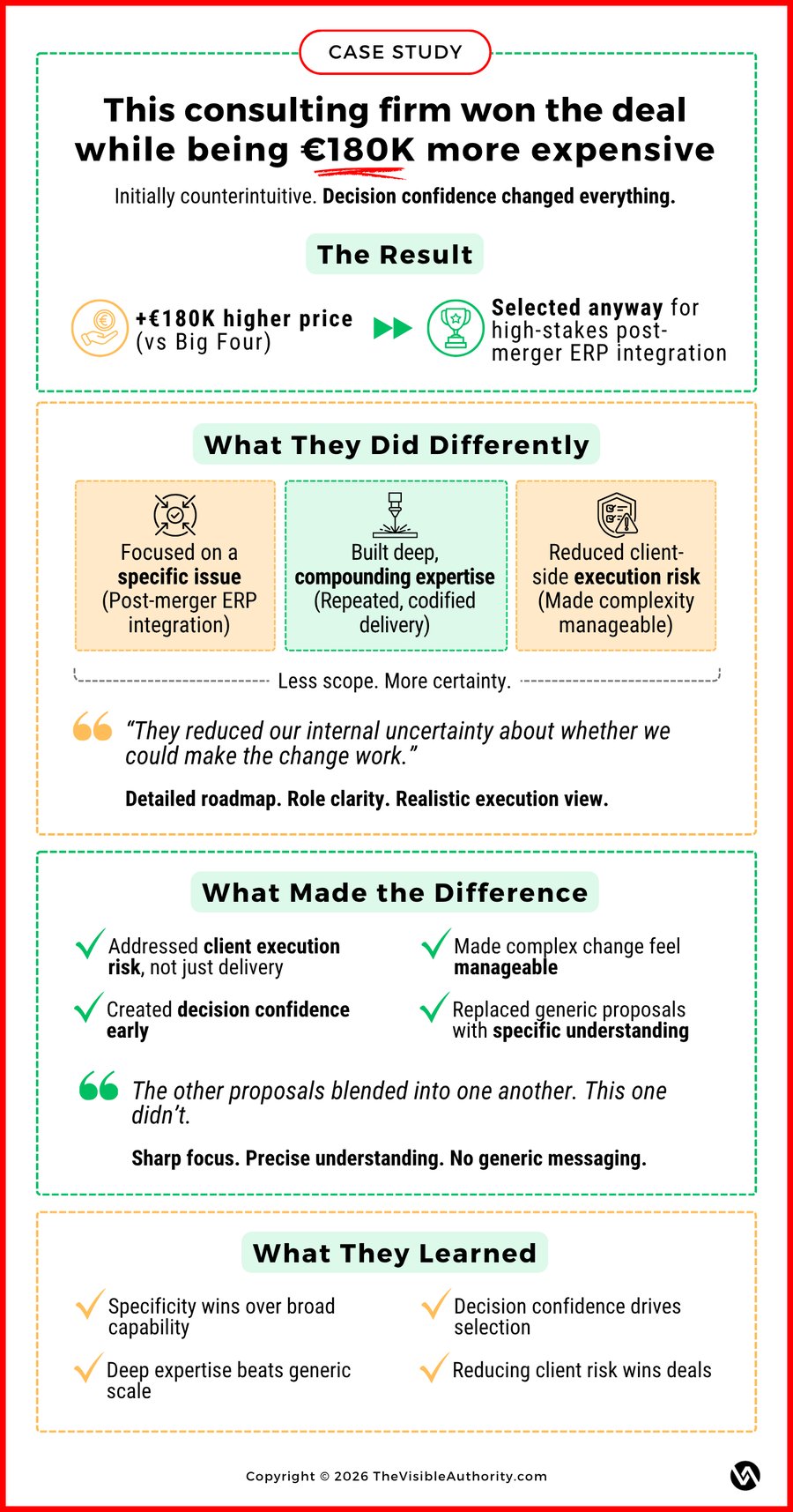
This winning consulting firm’s proposal came in approximately €180,000 higher than the programme budget of around €3 million for this post-merger ERP integration. Despite the higher price, the decision makers chose this consultancy with confidence, trusting its depth of expertise, its specific approach, and its proven ability to manage the immense complexity of the situation.
Several large consulting firms with global reach, strong brands, and broad transformation portfolios had been invited to pitch. Each consulting firm on the shortlist highlighted its impressive service list, wide capabilities, and bold transformation promises. On paper, many of the options looked attractive, structured, and complete.
Then this boutique consulting firm made its move. It did not present anything flashy and did not attempt to match the scale of the others in terms of resource capacity or breadth of offerings. It offered only one very specific proposition, focused entirely on this post-merger ERP integration.
The focus was singular, deliberate, and sharply defined.
For some in the room, the boutique size of the consulting firm felt risky at first. What followed, however, was a pitch that none of the other consulting firms were able to match, because it was built on depth of expertise and accumulated experience in handling the immense complexity of post-merger ERP integrations.
Unlike others, the consulting firm did not attempt to sell a broad list of services. It did not present expansive transformation narratives or discuss potential future phases beyond this post-merger ERP integration. Its consulting proposition stayed firmly anchored in what it knew in extraordinary detail: the disciplined execution of complex ERP integrations in highly regulated, politically sensitive, large-scale corporations.
This narrow focus did not feel like a limitation in that context. It felt precise and intentional. Over many prior engagements, the consulting firm had refined its proposition through repeated practice: it had encountered the same types of issues, such as conflicting data structures, stakeholder resistance, compliance challenges, and hidden dependencies, again and again. Each time, learning (including mistakes - some of them even explained during the pitch, yes) was captured, codified, and embedded into the delivery process.
This long cycle of repeated engagement in similar high-complexity environments yielded a depth of understanding difficult to replicate. The consulting firm was not simply talking about having completed many projects. It demonstrated the ability to recognise patterns early and anticipate where pressure and resistance would arise during post-merger ERP integrations.
In that room, what the client experienced was confidence grounded in evidence, specificity of experience, and a composed grasp of what this kind of integration actually required, both from the consulting firm and from the client organisation itself, which in turn created a higher level of decision confidence that had not been present in the proposals of the competitors.
|
Client testimonial #1: ‘Issue-led' “We saw several strong proposals from competing large consulting firms, but after a while, the pitch decks started to look remarkably similar: credentials, sector experience, capability overviews, case studies, and the usual ‘why us’ slides. They all signalled scale, capacity, capability, ambition, and bold promises, yet they largely blended into one another. The winning consulting firm stood out because it did not try to say everything about itself. It focused sharply on the specific post-merger challenges we were facing, spoke with unusual precision, and showed a depth of understanding that made the others feel far more generic by comparison.” |
When the consulting firm presented its plan, each phase of the post-merger ERP integration was laid out in an impressively detailed roadmap. It explained what would take place in the early weeks, how stakeholders would be involved across regions, where approvals and decision points would sit, how compliance requirements would be handled, and how data migration and system access would be managed in an environment of immense complexity.
This was not a conceptual framework displayed on a slide. It was a practical, experience-based execution roadmap shaped by past integrations of similar complexity. It showed where risks typically arise in this type of post-merger ERP integration and how those risks had already been addressed through specific design choices in the proposed approach.
More importantly, it gave the client something many competing consulting firms failed to provide: a defined path to outcomes and impact. It made clear not only what would happen, but how each stage of the work would reduce risk, build confidence, and move the organisation towards a stable, workable post-merger operating model.
In that sense, the roadmap functioned as a client success journey. It translated complexity into a sequence the client could follow, govern, and believe in.
For an organisation navigating a merger of this scale, this level of detail transformed uncertainty into something that could be understood, planned for, and governed. The consulting firm turned an overwhelming, chaotic situation into a sequence of manageable, transparent steps built on deep experience.
Recommended reading: Building a Winning Consulting Value Proposition
Post-merger ERP integrations are widely known for their volatility. Delays, budget pressure, stakeholder fatigue, and poor adoption are common. The consulting firm approached this challenge by drawing directly on its repeated exposure to similar conditions and levels of complexity. Through this repetition, it had learned to reduce outcome variance significantly.
Based on deep experience from previous post-merger ERP integration projects of comparable scale and difficulty, the consulting firm was able to speak with confidence about realistic adoption levels, anticipated system stability, and the continuity of operations during the transition. It explained where difficulties usually emerge and the mechanisms embedded in its process for detecting and mitigating those challenges early. Really impressive.
This shifted the proposal's context. The conversation became anchored in probability rather than hope. For decision makers who had to protect both the organisation and its revenue streams, this level of predictability carried far more weight than ambitious transformation language.
The immense complexity of this post-merger ERP integration became more manageable because the consulting firm had already reduced as many unknowns and risks as possible through repeated exposure, disciplined refinement, and codification.
A consulting firm that positions itself broadly can easily create ambiguity, particularly in a high-risk environment. A wide promise often demands faith in areas that have not yet been proven in practice. In this situation, the consulting firm took a very different route by defining its consulting proposition with strong specificity.
It explained that this post-merger ERP integration was precisely the type of challenge it had committed to mastering many years ago. It described how many similar scenarios it had already navigated, and how its approach had been shaped through years of disciplined, focused practice.
That level of specificity simplified the decision process. Doubt caused by an abundance of options was removed. Ambiguity and risk were reduced. The consulting firm did not attempt to impress through scale or scope. It built trust through precision and proven outcomes.
When the final proposals were compared, the consulting firm was not the cheapest option. Its bid was approximately €180,000 higher than that of one of the large, well-known consulting firms. On a total programme value of around €3 million for this post-merger ERP integration, this difference could have been an obvious point of hesitation.
By that stage, the discussion had already shifted far beyond initial pricing. Attention was on continuity of operations, protection of revenue, employee confidence, and stability during and after the merger. In that context, the higher price came to represent a greater likelihood of a controlled and predictable outcome.
For decision-makers, the additional investment was acceptable because it was associated with reduced risk in a situation marked by immense complexity and far-reaching consequences.
|
Client testimonial #2: ‘Internal risk reduction' “We were evaluating two very different kinds of project risk. The first was whether the consulting firm could deliver. The second question was whether we, as the client, could execute the change given competing priorities, stakeholder complexity, business-as-usual pressures, and the demands of a post-merger integration. Several competing consulting firms explained their plans well, but none addressed execution risk from our perspective, which made a substantial difference in how we evaluated the proposals. What gave us confidence in the winning proposal was the way they made our execution feel manageable: a detailed roadmap, role clarity in the early weeks, explicit decision points, stakeholder involvement across regions, and a realistic view of compliance, data migration, system access, adoption, and continuity. They reduced our internal uncertainty about whether our organisation could make the change work, which none of the competing consulting firms succeeded in.” |
Was this a case of David beating Goliath or a boutique firm outpitching a global giant? Maybe. But most of all, it was a masterclass in what truly wins consulting deals.
Many consulting firms continue to expand their offerings in the hope of increasing relevance and capturing more market share. Over time, this often increases internal complexity, spreads attention thin, and weakens the ability to deliver consistently in highly demanding environments.
The consulting firm in this story followed a different path. It deliberately narrowed its focus and committed to mastering a specific type of challenge: post-merger ERP integration. Through repetition, codification, and persistent refinement, it developed a consulting proposition that reduced variance, strengthened predictability, and created deep trust among stakeholders.
This approach did not reduce opportunity. It created a different kind of opportunity. One grounded in reputation, proven reliability, and the capacity to operate with confidence in situations defined by extraordinary complexity.
A consulting firm that chooses such a path builds strength through depth, not breadth.
|
The Principles of Consulting Proposition Design
|
The urge to promise more and to widen the scope is always present in consulting, we are experiencing it every day.
This often results in broader and vaguer messaging, extended service catalogues, and ambitious narratives about what could be possible in the future. This pitch, however, demonstrated a different, more powerful approach.
The consulting firm built its proposition on what it knew best: post-merger ERP integration. It relied on years of repeated work, accumulated learning, and codified practice. It converted immense complexity into a structured, comprehensible, and lowest-possible-risk path forward.
In addition to its deep expertise, the consulting firm was also perceived as highly transparent, credible, and authentic, with a leadership team whose reputation reinforced trust in its ability to deliver.
What made the difference was clear:
Depth over breadth: the consulting firm focused on a single challenge rather than offering a broad service offering.
Specificity over ambiguity: it defined its proposition with precision, making the decision easier for the client.
Codified experience over abstract promises: it showed a practical, experience-based, predictable path forward rather than relying on broad transformation language and promises.
Risk reduction: it reduced uncertainty by demonstrating how risk would be understood, anticipated, and managed.
Authenticity over polish: in addition to deep expertise, the firm was perceived as transparent, highly credible, and authentic, with leadership whose reputation reinforced confidence.
In high-stakes environments, decision makers place value on stability, predictability, and the confidence that complexity has been understood and accounted for. This consulting firm met those expectations through specificity, depth of knowledge, and disciplined execution.
The fact that the organisation selected this consultancy over a Big Four counterpart, despite a price difference of approximately €180,000, was not an accident. It was a direct result of how risk, certainty, and trust had been framed during the pitch.
For any consulting firm reflecting on its future direction, one question stands out. Perhaps the most significant advantage does not come from trying to do more, but from choosing one critical business problem, committing to it thoroughly, and mastering it to a level where outcomes become predictable even amid immense complexity.
That is what made this the best consulting pitch I have ever seen.
Interested in receiving all our learnings to build a better consulting firm?
Subscribe to our newsletter.