Why Consulting Firms Fail to Become More Strategic
“We want to become more strategic”.
Read more


2025 was the year consulting came face-to-face with its most fundamental weaknesses. A softer market, brutal budget scrutiny, and a noisy AI wave combined into a straightforward outcome: buyers started asking much sharper questions about where consulting fees actually go and what value they get in return.
The AI hype and the tools themselves hit consulting firms with a double bind.
When every consulting firm can access similar technology and generate similar outputs, the only viable way to stand out is through the depth of insight, the quality of the proposition, and the strength of the outcomes delivered over time.
In short, it has been a challenging year, one that we really think marks an inflexion point for the consulting industry. And that’s the lens through which we’ll look at 2025 in this article: the year as the point in time when long-standing habits in consulting started to show deep, structural cracks.
Or, as a consulting firm partner told us: “We seem to have entered a period of painful and public reckoning.”
For years, the default consulting model has been simple: assemble teams, load them with juniors, sell hours, and wrap everything in methodological language.
Many leaders knew that parts of this model were wasteful. Four people on a one-hour call. Pages of appendices nobody reads. Status meetings that exist only to generate billable time. But clients also accepted all those calls and meaty deliverables, so it worked for everybody, until now.
In 2025, tools like meeting recorders, AI note takers, and simple automation made this visible in a way that is hard to argue with. When software can show who spoke, what was said, who watched a replay, and what was actually used, a lot of ‘standard consulting work’ looks unnecessary.
Of course, these tools rarely replace real expertise. Instead, they made ‘the fat’ more apparent in 2025 than ever before. That transparency puts pure capacity plays under pressure, because buyers can now point to specific activities and ask, very calmly, why they are paying for them.
Increasingly, those questions are no longer hypothetical. Buyers can run a quick AI experiment on a sample of the work and see, in minutes, what used to take junior teams days. Once a CFO has seen that side‑by‑side, it becomes much harder to defend opaque staffing pyramids and vague “analysis” line items on the invoice.
On top of that, in our conversations with managing partners and leaders of consulting firms of various sizes, another consulting market insight emerged – the AI double squeeze.
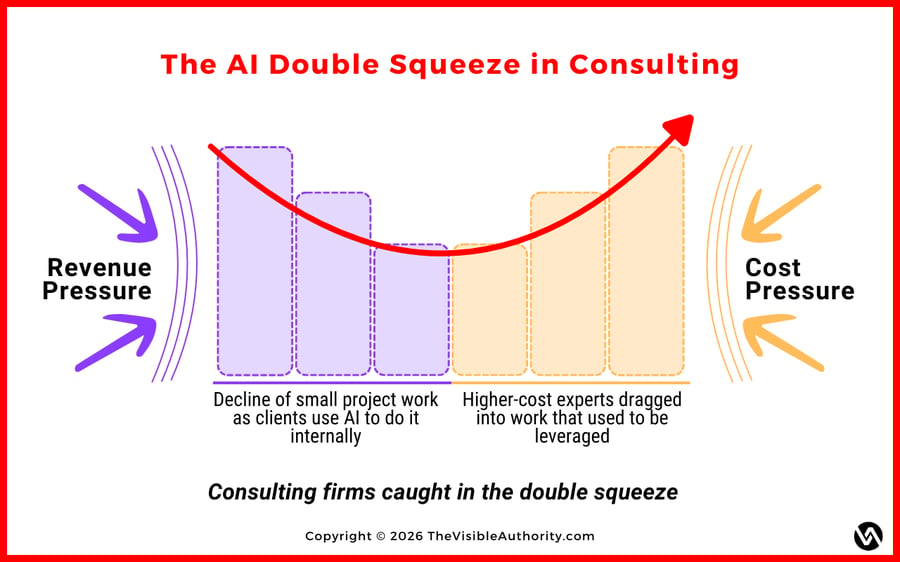 The AI Double Squeeze in Consulting
Many consulting firms generate a not insignificant percentage of their revenue from small, ad hoc projects: quick-turn surveys, basic segmentations, competitor scans, and ‘rapid insight’ decks, ahead of, e.g., board meetings or strategy off-sites.
In 2025, this part of the business shrank materially for many consulting firms as clients began generating first‑pass insights themselves, often with the help of AI tools plugged into existing survey platforms and internal data.
This small, order-take-like work had traditionally been delivered with a pyramid of juniors designing questionnaires, cleaning data, coding open‑ended responses, and assembling slide decks under senior supervision.
With these volumes dropping, consulting firms are forced to reduce junior headcount, which now (unfortunately) pushes more small, time‑critical requests directly onto senior experts (and sometimes even partners).
The double squeeze of AI is therefore:
Revenue pressure because of the declining small, order-taker project work
Cost pressure because higher‑cost specialists are now dragged into work that used to be leveraged.
Recommended reading: Why Big Consulting Firms Need a Better Proposition – Now More Than Ever
In conversations with several consulting firms and big firm practices this year, a common pattern emerged. Their broad, vague positioning is deliberate. They want wide nets. They present themselves as “the partner for everything in your function” or “the expert in your industry”, with almost every topic included somewhere. This worked as long as a strong logo, a wide bench, and senior relationships created enough trust.
2025 strained that equation.
Buyers are under pressure on speed, budgets, and personal risk. They want proof that a consulting firm has repeatedly solved their specific problem and can reduce the risk of failure in their context. At the same time, the AI hype pushed many consulting firms to add another layer of generic language on top, full of transformation claims and ‘AI-led’ promises that sound identical across competitors.
The result is a growing gap between what buyers need to hear to feel confident and what many consulting firms or practices still go to market with. AI is widening that gap at speed. When a client can feed their own data and a competitor’s proposal into a model and ask, “What’s actually different here?”, fluffy language gets stripped away in seconds. Consulting firms that cannot show a real advantage in method, data, or outcomes will increasingly see their decks reduced to interchangeable noise.
|
A Big 4 risk and compliance practice positioned itself as “the trusted partner for enterprise-wide risk management.” Its website, proposals, and pitch decks all told the same vague story: integrated frameworks, AI-enabled monitoring, global reach. It sounded impressive, but also almost identical to every other large player in the market. The partner: "What looks like a small shift in tooling is, in reality, the early stage of a much larger hollowing out of our “baseline” consulting work. As AI models improve, more discovery, synthesis, and first‑draft solutioning might move inside our clients, leaving us exposed wherever our "value" rests on manual effort rather than proprietary insight." The partner explained to us that a few renewal discussions (retainer contracts) have already shifted from, “How many hours/FTEs do we need next year?” to, “Which specific risk scenarios have you helped firms like ours reduce, by how much, and over what timeframe?” Their broad promise of “holistic risk transformation” suddenly felt thin. They came to us because they had finally recognised that their generic, copy-paste proposition no longer justified their cost base, and that they needed sharper, outcome-led propositions that a more educated client base could not so easily challenge. |
Behind the scenes, 2025 also changed the cost base of running a high-performing consulting firm.
For a long time, a consultancy could get away with a lean setup: hire bright graduates, let them learn on the job (paid by the client), give them a few internal templates, and carry headcount as the main investment. That is no longer enough to escape vulnerability to AI-driven disruption. To avoid being overtaken by the competition, consulting firms now face real choices:
Without those investments, firms risk ending up in the same position as traditional law practices or creative agencies: defending hourly rates for tasks that AI can already perform at near‑zero marginal cost. The danger is not that “AI replaces consultants” in a cinematic way, but that it relentlessly compresses "the billable surface area" of every engagement.
Consulting firms that will endure are those that can point to a sharply defined, issue-led proposition for a specific audience, with outcomes proven through repetition and proprietary data rather than promises. They keep turning that experience into differentiating IP that clients actually want to use, not just slides that describe it.
All of these require a change that many of the consulting firms we spoke to in 2025 consider as particularly difficult. It means testing those propositions with real prospects, and then creating a working go-to-market engine around them to strive for the compounding expertise. That work takes time from senior people, causes temporary dips in utilisation, and needs a real budget for research, experiments, and campaigns.
|
A mid-sized boutique research and market insights firm told us that a substantial share of its revenue used to come from ad hoc projects: quick-turn surveys, basic segmentations, competitor scans, and “rapid insight” decks ahead of board meetings or strategy off-sites. In 2025, this part of the business shrank materially as clients began generating first‑pass insights themselves, often with the help of AI tools plugged into existing survey platforms and internal data. The work had traditionally been delivered with a pyramid of juniors designing questionnaires, cleaning data, coding open‑ended responses, and assembling slide decks under senior supervision. With volumes dropping, the firm decided to cut junior headcount, which now pushes more small, time‑critical requests – “Can you validate this AI‑generated analysis before Monday?” – directly onto senior experts. A double squeeze: less revenue, and a margin hit because higher‑cost specialists are dragged into work that used to be leveraged. |
Before 2025, many firms could postpone this work and rely on broad promises that sounded similar across the market. The cost (or ‘tax’) of avoiding that work has gone up.
Each of these paths likely incurs meaningful upfront costs over the next two to three years. Not every consulting firm will be willing or able to make those bets. Larger firms have an advantage here because they have capital and experience with buying their way into new capabilities.
Smaller firms are nimbler but feel every investment decision much more directly. What no longer works is trying to coast on the old “people plus slides” model without any serious investment in depth or enablement.
Recommended reading: The Ultimate Guide to Consulting Value Proposition Design
This new cost base also exposed a leadership gap in consulting. Many firm owners and partners built their careers without having to take real investment risk. They built their success on relationships and broad capability-selling, not on focused bets.
When the conversation shifts to pulling people off the bench to build a new proposition, funding dedicated IP work, or committing to well-defined, high-stakes client problems for several years, many leaders hesitate.
In 2025, we heard stories of partners who once excelled at relationship-driven cross-selling and now feel lost and exhausted. Their habits and instincts were shaped by a market that rewarded opportunity-chasing. The next phase will reward different behaviour.
Someone in the consulting firm needs to decide which problems to own, where to invest, what to stop doing, and how to increase project repetition, pattern detection, and reduce outcome variance over time. Clients want outcomes, not project hours.
Another partner told us this move from ‘opportunistic chasing’ to ‘proposition design’ is much closer to (SaaS-like) product leadership than to classic partner rainmaking.
The consulting industry has only just started to face this shift.
Looking back at 2025, one pattern stands out. Firms that treat proposition design, focused project repetition, data codification, and outcome variance reduction as central topics are in a much stronger position than those that treat them as marketing decoration.
Winning firms or practices – large or small – define clear, issue-led, outcome-focused propositions that speak to real, current client risks and challenges. They decide where to build depth and then invest in training, IP creation, data, and methods that support that choice.
They run the same types of engagements often enough to learn from them, reduce surprises, and talk credibly about the odds of success. They are honest and transparent with clients about what they can achieve and what not.
2025 proved that the age of comfortable, vague capacity selling is over. The real, non-negotiable cost of staying in the game has been exposed, demanding a new level of conviction from leadership.
As AI continues to commoditise baseline knowledge and consulting firms increasingly face the pressure of the AI double squeeze, the ultimate differentiator will not be the tools themselves, but the firm's willingness to make focused investment bets in expertise, proprietary data, and a relentless focus on reducing outcome variance to build outcome-based propositions and proposals.
That's how consulting firms truly gain the trust and competitive advantage needed in the post-2025 era.
Interested in receiving all our learnings to build a better consulting firm?
Subscribe to our newsletter.



![[Case Study] Moving From a Generic to a Specific Consulting Value Proposition](https://www.thevisibleauthority.com/hs-fs/hubfs/Blog/Moving%20from%20a%20generic%20to%20a%20specific%20consulting%20value%20proposition%20.jpg?width=300&name=Moving%20from%20a%20generic%20to%20a%20specific%20consulting%20value%20proposition%20.jpg)