Why Cold Outbound in Consulting Doesn't Work. And What Actually Delivers Prospects.
This year alone, I spoke to 12 consulting firms that turned to cold outbound because "revenue was...
Read more


For decades, consulting firms have grown by selling expert capacity. Smart people, organised into projects and teams, monetised by the hour/day. It has been an extraordinarily successful business model, and it still generates most of the revenue in many consulting firms.
However, we increasingly see the same challenge across these consultancies: difficulty winning new clients and building a predictable revenue pipeline without compromising on pricing or stretching resources thin by continually customising pitches and project delivery.
This challenge is not temporary. And no type of consultancy is immune to it. These consultancies struggle because of a combination of internal and external pressures that have emerged as the industry has evolved.
While it may not be possible to walk away entirely from the capacity-selling model – nor would I advise any consulting firm to do so – it is worth considering rebalancing it with value-led work. This will help protect existing revenue while facilitating scaling and a healthy pipeline.
The consulting market didn’t change overnight. It has been shaped by years, and sometimes decades, of forces that define both how buyers make their decisions and how consulting firms operate. So attributing the current state of the market to a single element would be foolish.
Having said that, these are the four macro forces that have had the biggest impact on the traditional consulting model in recent years:
Many consulting firms have developed a revenue stream of small, ad hoc projects: quick-turn surveys, basic segmentations, competitor scans, and ‘rapid insight’ decks, ahead of e.g., board meetings or strategy off-sites.
Traditionally, a pyramid of juniors delivered these small, order-take-like projects by designing questionnaires, cleaning data, coding open‑ended responses, and assembling slide decks under senior supervision.
However, the rise of AI and automation tools has been increasingly shifting this type of work in-house. The result? Consulting firms have started cutting junior roles that would normally handle this type of work.
With these volumes dropping, this type of work gets (unfortunately) pushed directly onto senior experts (and sometimes even partners).
The AI double squeeze therefore manifests as:
The AI double squeeze is a new reality in consulting firms (or practices/verticals) of all sizes.
Consulting firms increasingly look and sound alike. AI has made consulting even more sameness-y.
Consulting firms already struggled to differentiate before AI arrived. Now, every consultancy can produce polished messaging, thought leadership, capability descriptions, proposals, frameworks, and insights at unprecedented speed.
The narrative may look impressive, but the market is filling up with more of the same.
Too many consulting firms sit under the same capability roofs, use similar language, and offer buyers too little (if any) reason to understand why a consulting firm is particularly relevant to a specific situation.
That big, ugly sameness creates a huge differentiation urgency.
Client hesitation is the silent deal-breaker of consulting proposals.
Consulting firm leaders tell us the same story again and again. A prospect shows genuine interest, asks thoughtful questions, and even agrees to a proposal. And then… nothing. Calls aren’t returned. Emails go unanswered. Deals drift into limbo, not because the offer was wrong but because the buyer couldn’t decide.
Decision hesitation has become one of the most underestimated barriers to growth in consulting. It’s not a lack of awareness. It’s not even the competition. It’s the prospect’s own fear of choosing “wrong” that stalls momentum.
Recommended reading: How Consulting Firms Can Overcome Prospects’ Indecisiveness
Consulting budgets face greater scrutiny. Buyers are under increasing pressure to justify expenditures on external partners and to demonstrate justifiable business impact of such engagements.
Of course, consulting as an industry is still in high demand. However, buyers have changed how they evaluate consulting firms.
Loosely defined work becomes harder to defend when buyers need a stronger economic case. Buyers are not looking for consulting firms that can help them with digital transformation using cutting-edge technologies. They are looking for high-impact, measurable outcomes that address meaningful business challenges.
In a way, the pressure is less about the budgets and more about the tangible, demonstrable value.
Because these pressures are negatively impacting consulting firms’ revenue, we believe consulting firms need to shift a larger share of their revenue from capacity-led to value-led work.
We increasingly believe the next stage of consulting requires a different design principle: Start with the value the consulting firm wants to create. Then design the business backwards from there.
We call this The Shift.
The Shift is the progressive redesign of a consulting firm around where it creates the greatest client value and how its expertise can repeatedly deliver that value. The ambition is to transform expertise and intellectual capital into repeatable client value and superior commercial performance.
It’s about consulting firms deliberately redesigning how expertise travels through the business and becomes client value.
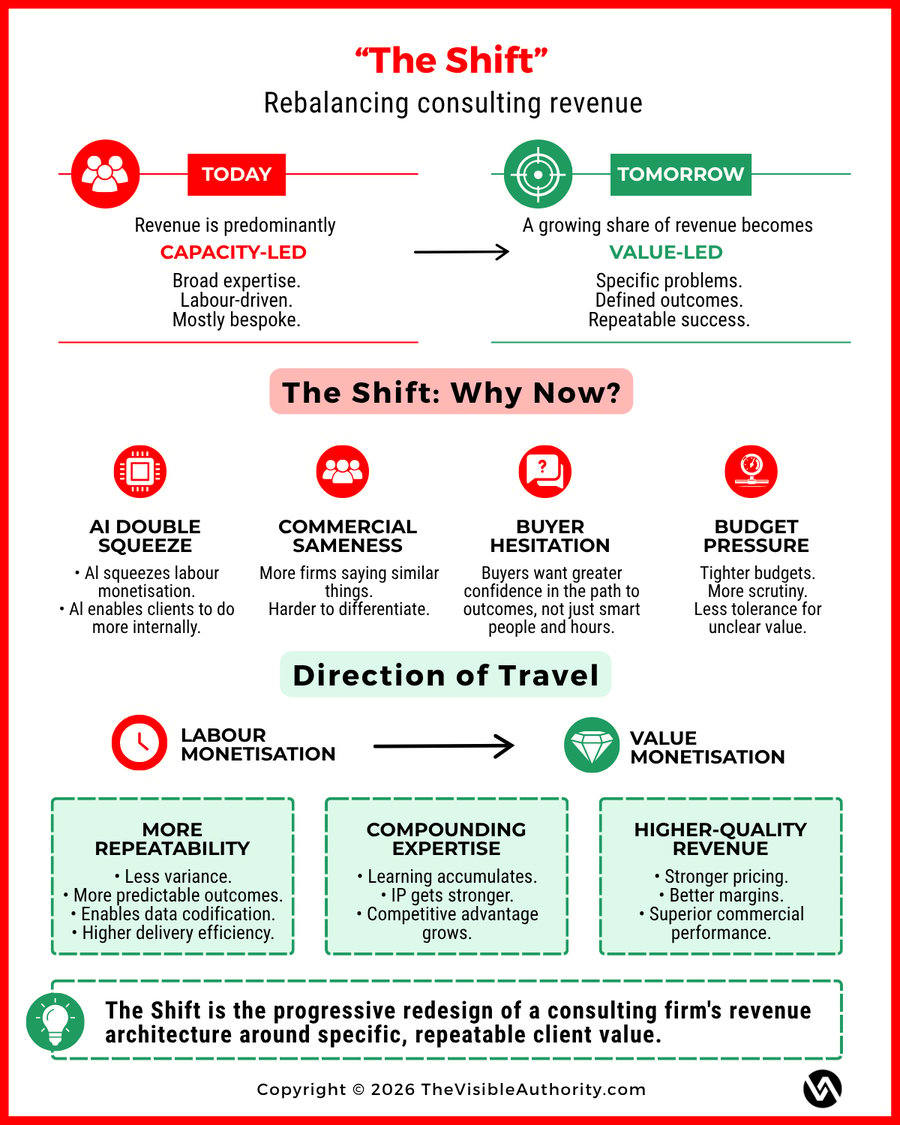 "The Shift"
There are eight foundations for making The Shift:
The first step is making choices – more specifically, choosing where the consulting firm wants to create meaningful client value.
It is simply impossible to build distinctive expertise around every problem, every client type, and every industry. Not in a way that would create value from the consulting work.
So the consulting firm needs to determine where it has the ability to create meaningful value for clients. That means being very clear about the problem it solves, the context, and the outcomes it delivers.
The next step is to find recurring problems, patterns, expertise and outcomes in the strongest engagements.
In fact, a common concern among consulting leaders when we discuss proposition (re)design is that they expect to have to reinvent everything: services, processes, client segments, even expertise. This is the opposite of what we advise.
In reality, most consulting firms already have a significant database of past engagements. The problem is that most of it is unorganised, unsystematised, and underutilised.
The answer lies in reviewing past work and identifying engagements where the consulting firm delivered exceptional value, earned high fees, built strong client trust, and delivered work that resulted in referrals.
Are there patterns in these successful engagements? A common thread across the type of problem that got solved, the processes that were implemented, or the type of client that the service was delivered to?
Step #3 is turning accumulated experience into firm-level IP that can be reused and improved.
Here, I’m referring to methodologies, processes, tech stacks, frameworks, datasets, templates, and other assets – everything that can be codified and continuously improved.
While some consulting leaders may fear this creates rigid boundaries around work, I would argue those boundaries help build expertise and intellectual capital over time, reduce costs, and deliver consistent, predictable results for clients.
Once the problem is defined and evidence from past work is aggregated, consulting firms should translate that expertise into propositions around defined problems, contexts, and outcomes.
This means moving away from service lists and vague, generic promises – the sameness of it all.
Strong propositions very clearly communicate to both clients and internally what problem the consulting firm addresses, what the context is, what the outcome is, and how that outcome is delivered.
Recommended reading: The Problem with Consulting Firms’ Outcome Claims
High-performing consultancies are able to achieve outstanding profit margins because (1) they can justify charging premium fees for the value of work they deliver; (2) they have optimised their costs through repetition.
That’s why the next step is to build a proven path consulting firms can repeatedly apply and contextualise.
Another advantage of repeatable client value creation is that it builds trust with prospects and helps convert them into clients. When a consulting firm can clearly communicate how it will take a client from Point A to Point B and what success looks like, the client feels more informed and better equipped to decide.
Ideally, every client engagement should reinforce the proposition. That’s why it’s important to capture outcomes and evidence – to be able to evaluate the process and continue to optimise it to strengthen the outcomes of the next engagement.
This evidence should be distributed internally. It should make its way to every aspect of the business – sales pitches, work delivery, marketing, and so on. The goal is to create an ecosystem that systematises proof and acts upon it.
Internal alignment is crucial – aligning education, marketing, sales, and pricing around the value the consulting firm creates.
Marketing should educate the market about the problems the consultancy understands exceptionally well. Sales should qualify prospects and offer initial diagnoses of possible root causes and a potential improvement plan. Pricing should reflect the value of the engagement.
To what end? To create a commercial system that revolves around why the work matters and who it matters to rather than around the labour and tech resources (capacity) the consulting firm would need to utilise.
Ultimately, the Shift needs to be measured. That’s why consulting firms should track whether expertise is becoming more commercially productive through stronger margins, pricing, revenue quality, and improving Revenue/FTE.
Does the expertise compound? To measure that, consulting firms can look at several indicators:
Is the delivery speed improving?
Is there continuous pushback on the pricing?
Is marketing capturing more qualified leads?
Is the sales cycle getting shorter?
How many clients have we acquired through referrals this year compared to last year?
and so on.
The Shift will be progressive. Existing revenue models will coexist with the emerging model, likely for years.
But the direction matters.
The consulting firms that deliberately turn accumulated expertise into increasingly repeatable client value can make every successful project strengthen the economics of the next one.
Value-led work starts with greater specificity around the problems a consulting firm repeatedly solves, the context in which it creates the most value, the outcomes it can credibly influence and the path it repeatedly uses to get there.
One question deserves a place on the leadership agenda:
"How much future growth should continue to come from adding labour, and how much can come from getting better at monetising expertise and intellectual capital?"
Interested in receiving all our learnings to build a better consulting firm?
Subscribe to our newsletter.


